

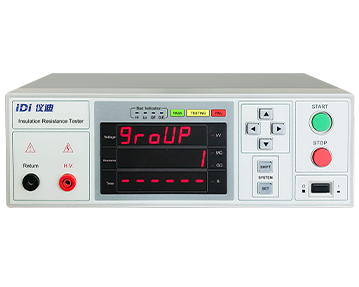
Insulation Resistance Tester
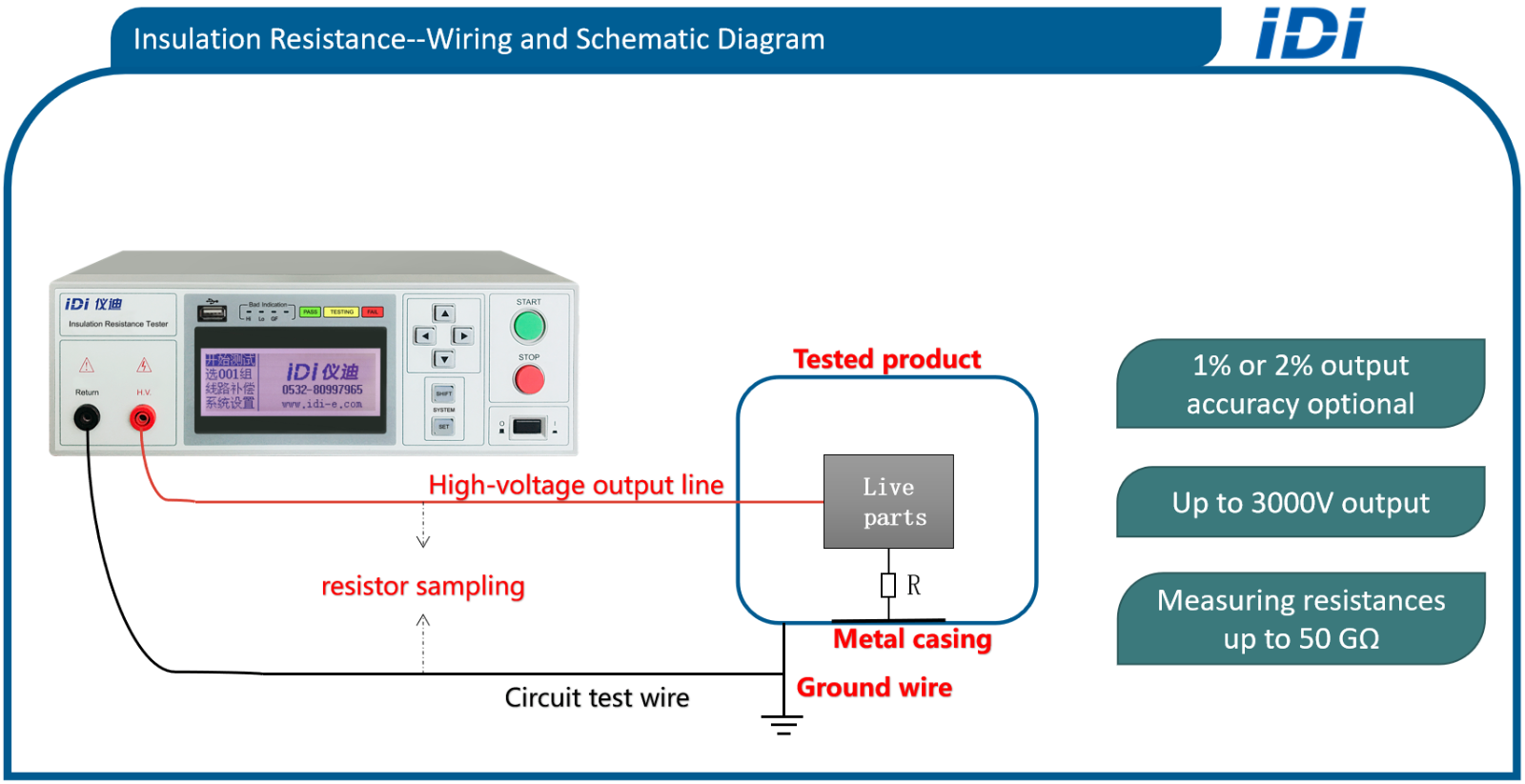
- It can test the insulation performance of all kinds of electrical products.
- There are various specifications to choose from, such as voltage output of 1000V or 3000V, and insulation resistance detection ranges of 10GΩ or 50GΩ.
- LCD display version, 1% Voltage output accuracy; LED display version, 2% Voltage output accuracy.
Equipment Introduction
1、IDI613XA/B-E insulation resistance tester, dedicated to electrical product insulation resistance testing. This series has multiple models with different ranges and configurations, allowing users to choose based on the insulation characteristics of the tested product; compact size, only 300mm wide and 112mm high.
This series includes LCD and digital tube models, with high and mid-end options. Easy to learn and operate, with 10 memory groups, each with 8 test steps, capable of single-step or continuous testing, suitable for testing products under different time and voltage levels to observe data.
The LCD model features Charge-Lo function, highly convenient and reliable for actual safety testing operations. Charge-Lo benefits: Quickly determines whether the wiring between the instrument and the tested object is properly connected during insulation resistance measurement, avoiding unreliable measurement data caused by poor connections. Since higher insulation resistance is better, operators usually only care about the lower limit not exceeding the threshold; the upper limit is not judged. However, poor wiring can cause the insulation resistance to appear “infinite” and the tested object to seem “good,” leading to unreliable results. The Charge-Lo function provides a direct method to judge wiring quality during insulation resistance testing. Almost any tested object exhibits capacitance characteristics, and a charging current will appear during insulation resistance testing. As mentioned, during the first Charge-Lo setting, the first measurement of the tested object is performed, ensuring good connection between the instrument and the object. When the operator presses the Test button to automatically set Charge-Lo, the instrument automatically sets half of the charging current as the Charge-Lo current and stores it. During the next measurement, if the instrument does not detect this current at the start or detects a lower current than the stored Charge-Lo current, it alarms and displays “Charge-Lo,” indicating poor or unreliable connection (such as multiple strands of wire interrupted).
2、Industry Applications:
Home appliances, commercial appliances, 3C consumer electronics, medical devices, lighting fixtures, charging piles, electric vehicles, rail transit, power electronic devices, power equipment, energy industry, motor coil products, power tools, third-party laboratories, and certification and quality inspection agencies.
3、Equipment selection:
Equipment selection | |
IDI6130A-E |
Digital tube display, 2% voltage output accuracy, 1000V/3000MΩ |
IDI6131A-E |
Digital tube display, 2% voltage output accuracy, 1000V/10GΩ |
IDI6135A-E |
Digital tube display, 2% voltage output accuracy, 1000V/50GΩ |
IDI6131B-E |
LCD screen display, 1% voltage output accuracy, 3000V/10GΩ |
IDI6135B-E |
LCD screen display, 1% voltage output accuracy, 3000V/50GΩ |
Configuration | |
Size |
300W*370D*112H, unit: mm |
Configuration |
LCD or digital tube display, interfaces: PLC & communication port & USB (LCD models) |
Standard accessory |
Power cord (2 meters), remote switch line (1.1 meters), high-voltage rod (1.5 meters), return line (1.5 meters), communication cable (3 meters) |
Working conditions |
Power supply: Configure according to the power grid of the country where this product is used. |
Ambient temperature: 0-40°C | |
Environmental humidity: 20-80% RH | |
4、Basic knowledge of electrical safety performance:
Insulation resistance testing: Insulation resistance is an important electrical parameter reflecting the performance of insulating materials. This item can assess the insulation performance of the tested object, whether it is damp or contaminated. It mainly measures the equivalent resistance formed by the connection of two endpoints and their associated networks, ensuring the safe operation of electrical equipment by meeting minimum insulation resistance requirements for conductors of different polarities.

